AG 0140–LIVESTOCK COVERAGE
(February 2025)
INTRODUCTION
The American Association of Insurance Services (AAIS) AG 0140–Livestock Coverage endorsement is used with the AAIS Agricultural Output Program to provide coverage for various types of livestock. It is attached to AG 0100–Agribusiness Property and Income Coverage Part. This endorsement is not complete without the AG 0100. Instead, the AG 0140 amends the following parts of the AG 0100 to provide coverage, and even then, the amendments apply only to the coverage being provided by the endorsement:
· Agreement
· Property Covered
· Property Not Covered
· Supplemental Coverages
· Perils Covered
· Perils Excluded
· Valuation
· How Much We Pay
· Other Conditions
AGREEMENT
The insurance company provides the coverage described in this endorsement during the policy period in exchange for the named insured's premium payment. This endorsement is subject to CL 100–Common Policy Conditions and the following sections in AG 0100–Agribusiness Property and Income Coverage Part:
· Declarations
· Definitions
· What Must Be Done In Case Of Loss
· How Much We Pay
· Loss Payment
· Other Conditions
PROPERTY COVERED
Only the livestock listed and described in the declarations is covered.
PROPERTY NOT COVERED
Coverage does not apply to the following property. Exceptions, if any, will be listed on the declarations.
1. Contraband
These are goods that are illegal to possess or legal but in the course of illegal transportation.
|
|
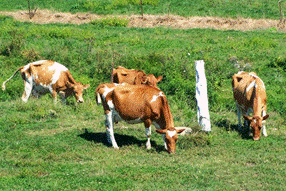
Example: Marty hires Jerry to transport forty head of cattle to market. The cattle are usually covered. However, when the cattle are transported, Marty’s farm is under government-ordered quarantine. Any loss to the cattle during transportation is excluded because the activity is illegal. |
2. Waterborne Livestock
There is no coverage for livestock transported by water. There is an exception. Livestock being transported on ferries or other transfer boats is covered if the water transportation is part of a transport that includes rail or other land routes.
3. Carrier for Hire
When the named insured carries livestock for hire, there is no coverage for the livestock of others.
4. Livestock Not Described
Coverage is limited to only livestock specifically described in the declarations. All other livestock is not covered.
5. Other Property
This endorsement covers only livestock. All other property is not covered.
SUPPLEMENTAL COVERAGE
This Supplemental Coverage applies only when Off-Premises Power Interruption Coverage is selected on the declarations.
Off-Premises Power Interruption
Loss of livestock due to an electrical power interruption in the building or structure where the livestock are housed is covered, provided the power disruption results from direct physical damage to the off-premises power source caused by a covered peril under this endorsement.
PERILS COVERED
The perils covered differences between AG 0100, and the AG 0140 are significant. The AG 0100 covered perils are risks of direct physical loss or damage, subject to certain exclusions and limitations. AG 0140–Livestock Coverage applies to only losses caused by the perils listed below. This reduced coverage is an important difference that may be overlooked if not brought to the customer's attention when the policy is delivered.
The protection options are Basic or Broad Perils. Broad Perils include six perils in addition to the 14 Basic Perils. Earthquake or Volcanic Eruption Coverage can be added to either selection.
1. Basic Perils
When basic perils is listed on the declarations, coverage is limited to direct physical loss to covered property caused by the following specific perils, subject to the endorsement exclusions.
a. Fire
b. Lightning
c. Explosion
This coverage does not include loss or damage caused by sonic booms.
d. Windstorm or Hail
This coverage does not insure loss to livestock due to any of the following, even if a result of windstorm or hail:
· Frost
· Cold weather
· Ice, snow, or sleet, whether or not driven by wind. Hail is not considered ice.
· Livestock running into streams, ponds, or ditches, against fences, or other objects
· Being frightened or smothered either directly or indirectly
· Being smothered or frozen in snowstorms or blizzards
e. Aircraft or Vehicles
Direct
physical contact between the livestock and aircraft, spacecraft, missiles, or
vehicles is covered. This also applies if the contact
is with the building holding the livestock. The term vehicle includes the
animals pulling the vehicle. If objects fall from an aircraft or are thrown up
by an aircraft or vehicle and make direct physical contact with the livestock
or the building holding the livestock, there is also coverage.
Note: Aircraft is not defined, so it could include direct
contact with a drone or unmanned aerial vehicle (UAV).
|
|
|
Example: Gravity Plus Farms arranges to
transport 30 sheep to market by air. While waiting to board the aircraft,
another plane lands. Its landing wheel sheers off, flies into the paddock
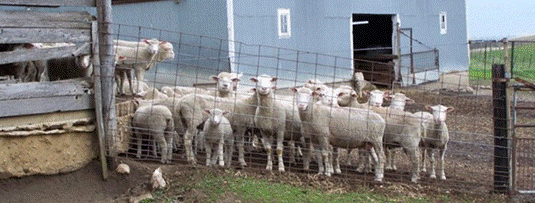
holding the sheep, and kills two of the sheep. This loss is covered. |
f. Smoke
When smoke occurs accidentally and suddenly, causing loss or damage, there is coverage, but if the smoke is due to agricultural smudging or industrial operations, there is no coverage.
g. Riot or Civil Commotion
In addition to riot and civil commotion, the insurance company pays for loss or damage due to the following:
·
Acts of employees who are on strike but only while
they occupy a covered location
·
Pilferage and looting that takes place at the
same time and place of civil commotion or rioting
|
Example: Arnie
hears that a riot is taking place in another part of town. He knows the
sheriff and his deputies will be busy, so he decides to use the riot to cover
his theft of some of Fred’s livestock. However, the coverage this peril
provides does not apply to Fred’s stolen livestock. |
h. Collision
Collision is expanded to include not only collision but also upset and overturn of any vehicle transporting the covered livestock.
i. Sinkhole Collapse
This is the same definition that is in AG 0100.
j. Collapse of a Bridge or Culvert
k. Stranding, Sinking, Burning, or Colliding of Ferries or Other Transfer Boats
In addition to damage caused by the stranding, sinking, burning, or colliding of ferries or transfer boats, there is coverage for general average costs. Under Marine law, the sacrifice of one to save the rest must be shared by the rest. So, if the cargo of one shipper is thrown overboard, the loss of that cargo is shared by all shippers on the vessel proportionate to the value of their property on the vessel. Both the proportionate value of the cargo and the proportionate share of the cost to save property that is saved are covered under this peril.
l. Theft or Attempted Theft
Theft is defined under the AG 0100. However, the following losses are not covered:
· Any theft discovered while taking inventory
· Theft that is due to embezzlement or wrongful conversion
· The escape or mysterious disappearance of the livestock
· Loss resulting from accepting counterfeit money, fraudulent post office or express money orders, checks, or promissory notes that are not honored when presented
· Livestock transferred based on unauthorized instructions
m. Flood
Flood refers to the overflow or inundation of water into areas that are typically dry or previously not submerged. The flooding can be caused naturally, artificially, or accidentally by any of the following:
· Waves, tidal waves and tsunami
· Tidal water and tides
· A body of water that overflows
· Storm surge, storm tide, and tidal surge
· Surface water that runs off, collects quickly or unexpectedly from any source
Note: Any of the above could include spray and/or may or may not be accompanied by wind.
n. Volcanic Action
This is the same definition located in AG 0100.
2. Broad Perils
Direct physical loss to covered property caused by any of the Basic Perils outlined above plus any of the following perils are covered when Broad Perils is listed on the declarations.
This coverage is subject to Perils Excluded.
a. Vandalism
This peril pertains specifically to intentional or malicious harm to, or destruction of, covered property.
b. Accidental Shooting
c. Drowning From External Cause
d. Electrocution
e. Attack by a Dog or Wild Animal
f. Collapse of a Building or Other Structure
Note: Except for vandalism, none of these Broad Perils is
further defined. This means that coverage is based on the peril’s name or
title. It also means that the definition may be broadly defined and interpreted
at the time of loss.
3. Optional Peril, Earthquake, or Volcanic Eruption
Coverage applies to direct physical loss to covered property that earthquake or volcanic eruption causes when this coverage is selected on the declarations. This coverage is subject to Perils Excluded.
Earthquake is not defined.
However, volcanic eruption includes eruption, explosion, and effusion of a volcano. All earthquakes or volcanic eruptions that take place within 168 consecutive hours are considered a single loss. This period is not affected by the expiration date. This means if the earthquake strikes the day before the policy expires, coverage continues for all aftershocks that may occur in the next six days even though the policy has expired.
PERILS EXCLUDED
1. Primary Exclusions
The first group of exclusions applies whether the loss event results in widespread damage or affects a significant geographical area or not and are essentially absolute.
Subject to specific exceptions, each is totally excluded, regardless of any other cause or event contributing to a loss, either concurrently or in any other sequence. The insurance company does not pay for any direct or indirect loss or damage caused by or that results from any of these events.
a. Civil Authority
Loss or damage caused by the order of any civil authority is not covered. Examples of such loss or damage include the seizure, confiscation, destruction, or quarantine of property. However, there is coverage if a civil authority orders the destruction of property to prevent a fire from spreading, but only if the fire was caused by a covered peril. If the fire is caused by an excluded peril, it is not covered.
|
Example: The local fire department burns
down the Finnegans’ breeding barn to act as a firebreak against an advancing
forest fire caused by a lightning strike. The loss of livestock in the barn is
covered. |
b. Nuclear Hazard
Coverage
does not include any loss caused by or resulting from a nuclear reaction,
nuclear radiation, or radioactive contamination. This applies regardless of
whether the event is controlled, uncontrolled, or caused by natural,
accidental, or artificial means. Losses resulting from nuclear hazards are not
classified as losses caused by fire, explosion, or smoke. However, there is an
exception for direct losses resulting from fire caused by the nuclear hazard.
Note: Coverage for nuclear risks is available through
only nuclear coverage associations.
c. Earth Movement or Volcanic Eruption
Damage to covered property caused by earthquake, landslide, mudslide, mine subsidence, sinking, rising, shifting earth, and earth movement caused by volcanic eruption, explosion, or effusion is excluded. However, sinkhole collapse is not included in this exclusion.
If property is damaged by fire, explosion, or volcanic action resulting from natural events such as earth movement, eruption, explosion, or the effusion of a volcano, coverage is provided specifically for the fire damage caused by these events. Volcanic eruptions that occur within a 168-hour period are considered a single occurrence. Additionally, if volcanic action begins at the end of the policy period, coverage will extend into the next policy period, as the 168-hour timeframe remains unaffected by the policy's expiration.
If the Optional Peril for Earthquake or Volcanic Eruption is selected on the declarations as covered, there is coverage as described in the Optional Peril; however, the following losses are still not covered:
· Any earthquake or volcanic eruption that begins prior to the policy’s inception date.
· Blasting, landslide, mine subsidence, mudflow, or mudslide, even if triggered or caused by an earthquake or volcanic eruption. However, this does not include blasting from a volcanic explosion.
· Flooding, tidal wave, or tsunami that occur as a result of an earthquake or volcanic eruption.
Note: If
the earthquake or volcanic eruption starts within 72 hours of the policy’s inception
date and the prior policy does not
include earthquake coverage, the Optional Peril for Earthquake or Volcanic
Eruption still applies.
d. War
Note: The war exclusion in
this form is deleted and replaced by a mandatory exclusion AG 0135–Exclusion –
War and Military Action. Because the exclusion is mandatory, it is analyzed in
place of the exclusion in the form.
Loss or damage that is caused either directly or indirectly by the following activities are not covered:
· War. This is any type of war. It could be undeclared or civil.
· Actions taken by a government, sovereign, or authority that are warlike, utilizing military force. This includes deploying military personnel or other agents to prevent or protect against such attacks, whether actual or anticipated.
· Internal actions such as insurrections, revolution, usurpation of power, and revolution. This exclusion applies to not only the internal actions of the party instigating the warlike action but also any responses by any type of governmental authority.
Superseded Exclusion: This exclusion takes precedence over any Nuclear Hazard exclusion if any of the above actions involve activities that would be otherwise excluded under the Nuclear Hazard exclusion.
Note: This
last paragraph is very important because the Nuclear Hazard provides a limited
amount of coverage for fire due to nuclear war, but this exclusion does not.
e. Utility Failure
Losses resulting from the interruption of power or utility’s failure to supply its service to the insured is not covered if the failure occurs off the insured’s covered location. This includes power failures such as reduced or increased voltage, lower pressure, or other disruptions of normal service.
There are two exceptions.
· If the utility failure causes damage due to a covered peril, the resulting damage is covered.
·
If Supplemental Coverage Off-Premises Power
Interruption coverage is provided, the utility failure exclusion does not apply.
2. Secondary Exclusion
If weather conditions lead to any of the excluded perils mentioned in paragraphs 1a-1e, coverage will not be provided for loss or damage resulting from those excluded perils. However, any resulting losses caused by covered perils are eligible for coverage, unless the specific loss itself is excluded.
VALUATION
The value of livestock owned by the insured is determined based on the actual cash value as of the day the loss occurs. This same principle applies to livestock owned by others for which the insured is legally responsible. However, there is an important stipulation: the insurance will cover no more than the amount for which the insured is legally liable.
HOW MUCH WE PAY
The following replaces AG 0100’s Loss Settlement Terms, Coinsurance, Property Covered Other than Builders' Risk and Value Reporting under How Much We Pay:
1. Loss Settlement Terms, Livestock
Subject to the provisions in the How Much We Pay section, the most the insurance company will pay for livestock is as follows:
· Each Animal
The most that is paid for the loss of any one animal is the Each Animal Limit entered on the declarations.
· All Animals
The most that is paid in a single occurrence is the All Animals Limit on the declarations.
The declarations limit may be shown by type or class of animal.
2. Coinsurance, Livestock
This provision applies separately to each item or type of covered property subject to coinsurance.
The insurance company pays only part of a covered loss when the limit of insurance at the time of loss multiplied by the corresponding coinsurance percentage is less than the covered property’s loss.
However, if the value calculated is less than the limit, a penalty calculated as follows is applied:
Step 1. Multiply the livestock's value at the time of loss by the coinsurance percentage.
|
Example: Livestock Value at time of loss
is $11,000 x 80% Coinsurance = $8,800 |
Step 2. Divide the limit for the covered property by Step 1.
|
Example: Covered Livestock Limit is $10,000
/ $8,800 = 88% |
Step 3. Multiply the total amount of loss by Step 2.
|
Example: Total Loss $11,000 x 88% Coinsurance Penalty =
$9,680 |
Step 4. Subtract the deductible from Step 3.
|
Example: $9,680 - $1,000 Deductible = $8,680 Total Amount
Paid for the Loss |
The most the insurance company pays is the lesser of the amount determined in Step 4 or the limit of insurance. If the amount paid is less than the loss, the named insured must pay the difference.
There is no penalty if, at the time of loss, the calculated value of the covered property is less than the policy's limit of insurance.
3. Value Reporting, Livestock
If Value Reporting is listed on the declarations, then this condition applies. The insurance company requires the insured to submit monthly reports as described in the policy. These reports must be filed with the insurance company within 30 days of the end of each calendar month and at expiration. The reports must contain the full property values, separated by kind, type, and location of the livestock.
a. Full Reporting
The insurance company adjusts the amount of loss, using the latest report of values, as follows:
· Step 1: Divide the latest values reported prior to the loss by the actual values that existed on the date of the report.
Note: This should be 100%. However, if the actual values are less than the values reported, they are under-reported, and a penalty applies.
· Step 2. Multiply the total amount of loss by the amount determined in step 1.
· Step 3. Subtract the deductible from the amount determined in step 2.
The most the insurance company pays is the lesser of the amount determined in step 3 or the limit. It does not pay any remaining part of the loss.
This calculation is made on the same basis as the report because it is based on locations and types or class of livestock.
|
Examples: The livestock limit
is $100,000, and the deductible is $1,000. The loss amount is $50,000. Scenario 1: The last value reported is
$90,000, and that amount is the actual value as of the reporting date. Step 1: $90,000
value reported divided by $90,000 actual value equals 100%. Step 2: $50,000
amount of loss multiplied by 100% equals $50,000. Step 3: $50,000 minus the $1,000
deductible equals $49,000. This is the amount paid. The named insured pays
the $1,000 deductible amount. Scenario 2: The named insured reports
$75,000, but the value was $90,000. Step 1: $75,000
value reported divided by $90,000 actual value equals .833. Step 2: $50,000
loss multiplied by .833 equals $41,650. Step 3: $41,650 minus the $1,000
deductible equals $40,650. This is the amount paid. The named insured pays
$9,350. |
b. Failure to Submit Reports
This provision applies to each covered location and each class or type of livestock involved in a loss.
· The first report may be due but has not yet been received when a loss occurs. If this is the case, the insurance company does not pay more than 90% of the loss it would have otherwise paid.
· The first report may have been made, but a subsequent report that is due is not yet received when a loss occurs. In that case, the insurance company does not pay more than the amount reported in the latest report it received.
c. Premium
The premium
for this coverage at the start of the policy term is considered an advance
premium for all property subject to reporting. The insurance company calculates
a final premium at the end of the coverage period or the date when coverage is
canceled. This calculation is based on the average of all values reported.
If the final premium exceeds the advance premium, the named insured must pay the insurance company the difference. Conversely, if the final premium is lower than the advance premium, the insurance company will refund the difference to the named insured, subject to any minimum premium requirements.
Premiums can be adjusted for periods other than annual if stated on the declarations.
The reporting period may be amended by agreement. The amended reporting period will be reflected on the declarations.
OTHER CONDITIONS
Death of Livestock
This condition applies to livestock death if caused by a covered peril under this endorsement. Coverage may also apply if death occurs in the course of theft or attempted theft of livestock.